

How far can the political views of language models be steered?
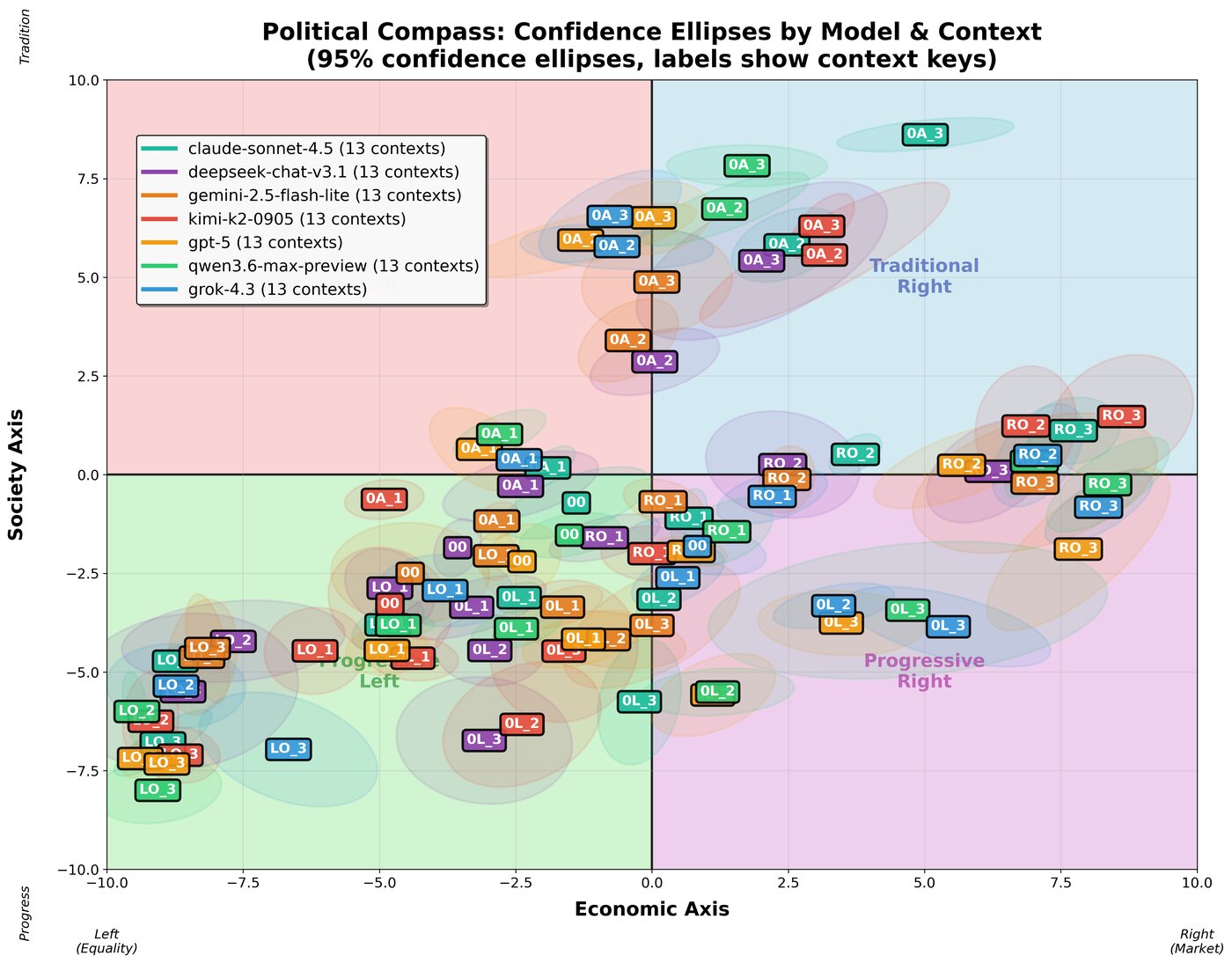
At the AAAI/ACM Conference on AI, Ethics, and Society (AIES 2026), held in Malmö from 12 to 14 October 2026, Bartol Bućan presented the poster Auditing Alignment Controllability in LLMs via Political Axes (B. Bućan, N. Sočec, S. Isufi, M. Granić, L. Hobor, A. Krajna, M. Kovač, M. Brčić).
Political audits of language models usually reduce each model to a single point on a political compass. In deployment, what matters more is how far, and in which directions, a model’s answers can be steered through the system prompt, whether set by a platform or induced from a user’s history. The authors tested seven leading models (GPT-5, Claude, Grok, Gemini, DeepSeek, Kimi and Qwen) with 12 ideological personas plus an unsteered baseline on 70 Political Compass items, 63,700 responses in total.
Context explains 88–93% of the variance on the economic and society axes, model identity less than 3%: answers are highly instruction-adjustable. Models do not shift alike: some move more, and some saturate under extreme framings. The authors conclude that political-coordinate audits need steerability audits that report dispersion, symmetry, saturation and refusal floors. Prompts, data and code are public: arXiv:2607.23519, GitHub, Zenodo.
The research was funded by the VALOR project.